

By 1855, What Did The Makeup Of Freetown Look Like?
More than half-dozen centuries ago, tribes from the African interior decided to settle in the virgin forest, where they would be protected by the mountains on one side and the bounding main on the other. They were probably the ancestors of t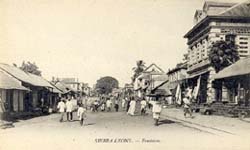 he Limbas, the oldest indigenous grouping in Sierra Leone, the coastal Bulom (Sherbro), Tine, the Mande-speaking people including Vai, Loko and Mende.
Portuguese sailors were among the first Europeans to discover the site of what is at present Freetown. Equally foreign influence increased, trade commenced between the locals and Europeans in the form of a barter system. The British began to accept involvement in Sierra Leone and in 1672 the Royal African Company established Forts on the Islands of Bunce and York for trading. With the emergence of the slave trade, human existence became the major commodity in the market. Indigenes were sold as slaves. In fact, Bunce Isle became a prime spot for the transporting of slaves to Europe and America.
Through the efforts of some British philanthropists, slavery was abolished in England. A naval base was established in Freetown to intercept slave ships and also to serve as settlement for freed slaves in 1787. This settlement was called the 'Province of Liberty.' By 1792, 1200 slaves were thereby sent to Freetown from Nova Scotia and a large number from Maroon in the 1800s to bring together the original settlers from England. Few years afterwards in 1808, the colony officially became a British Crown Colony. Merchandise commenced between the indigenes and the settlers. This paved the gateway for the British to infiltrate the protectorate- the need to extend their rule became necessary. In 1896, a protectorate was declared. The country then became a single entity with a shared history, culture and language chosen krio which evoked out of the fatua and mixed languages of various other settlers and traders. English became the official linguistic communication.
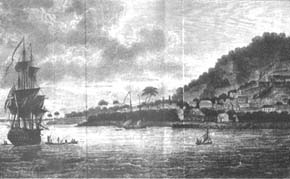 During British colonialism, Sierra Leone served as the seat of Government for other British colonies along the West Coast of Africa. The first higher for higher education due south of the Sahara was established in 1827. The state is well known for its early achievements in the fields of medicine, law and instruction earning the name 'the Athens of West Africa'.
In 1787, British philanthropists founded the "Province of Liberty" which later on became Freetown, a British crown colony and the principal base of operations for the suppression of the slave trade. By 1792, 1200 freed slaves from Nova Scotia joined the original settlers, the Maroons, another group of slaves, rebelled in Jamaica and traveled to Freetown in 1800.
Through the efforts of such men equally William Wilberforce, Thomas Clarkson and Granville Sharp, Lord Mansfield formed an assistants in 1806, which was instrumental in the British Empire'southward abolition of the Trans-Atlantic slave merchandise (1807). The British established a naval base of operations in Freetown to patrol against illegal slave ships. A fine of GBP £100 was established for every slave found on a British ship.
In 1808 Sierra Leone officially became a crown Colony with the state possessions of the Sierra Leone Company (formerly known as St. George'south Bay Company) transferred to the crown. The colony was dedicated to demonstrating the principles of Christianity, culture and commerce.
In 1833 British Parliament passed the Emancipation Act, and 1883 slavery was finally abolished. It wasn't until 1865; the United States passed the 13th subpoena abolishing slavery.
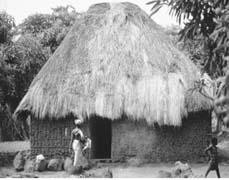
By 1855, over 50,000 freed slaves had been settled in Freetown. Known as Krios, the repatriated settlers of Freetown today alive in a multi-ethnic country. Though English is the official language, Krio is widely spoken throughout the country allowing unlike tribal groups a mutual linguistic communication.
During British colonialism, Sierra Leone served as the seat of Government for other British colonies along the W Coast of Africa. The first higher for college didactics south of the Sahara was established in 1827. The land is well known for its early achievements in the fields of medicine, police and teaching earning the name 'the Athens of W Africa'.
Sierra Leone gained independence on the 27th of April 1961 and the Republican status on the l9th April 1971. Since independence there have been many changes in the socio- political, and economic spheres.
The outbreak of the war in Sierra Leone caused set back to many areas in the country. The conflict in Sierra Leone started in March 1991 when fighters of the Revolutionary United Front (RUF) launched a war from the east of the country near the border with Liberia to overthrow the government. With the support of the War machine Observer Group (ECOMOG) of the Economic Community of West African States (ECOWAS), Sierra Leone'southward army tried at first to defend the government but, the post-obit twelvemonth, the ground forces itself overthrew the regime. The RUF continued its attacks.
On xviii January 2002, the war in Sierra Leone was officially declared over.
Source : Sierra Leone Visitor Information
State Firm
Sierra Leone Web
Sierra Leone National Tourist Board

By 1855, What Did The Makeup Of Freetown Look Like?,
Source: https://unipsil.unmissions.org/about-sierra-leone-history
Posted by: arnohaductincer.blogspot.com
0 Response to "By 1855, What Did The Makeup Of Freetown Look Like?"
Post a Comment